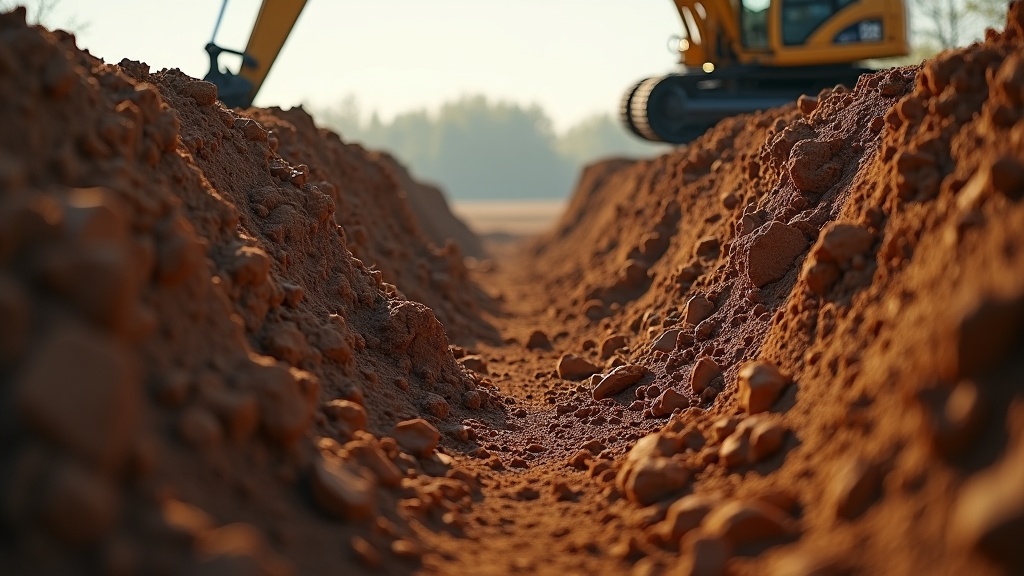
Backfill a Trench: Mining & Utility Compaction Rules
Learn how to properly backfill a trench in mining and utility projects. Discover key compaction standards, lift thickness limits, and material selection rules.
Table of Contents
- Article Snapshot
- Market Snapshot
- Introduction
- Material Selection for Trench Backfill
- Compaction Standards and Lift Thickness
- Mining and Tunneling Applications
- Testing and Quality Control
- Your Most Common Questions
- Comparison of Backfill Methods
- Practical Tips
- Before You Go
Article Snapshot
When professionals backfill a trench, they refill an excavation with soil, aggregate, or grout to restore structural support and prevent surface settlement. Proper execution requires strict adherence to material specifications, moisture control, and mechanical compaction standards to ensure long-term stability for buried utilities and mining infrastructure.
Market Snapshot
- Utility trench final backfill must typically achieve at least 90 percent relative compaction to provide a stable surface (Calichi Design Group, 2024)[1].
- For trenches under pavements, backfill relative compaction requirements commonly increase to 95 percent to limit settlement (Calichi Design Group, 2024)[1].
- Backfill for many utility trenches is placed in a maximum 6-inch lift thickness around the pipe to ensure thorough compaction (Calichi Design Group, 2024)[1].
- Material placed within one foot of piping must contain no stones larger than 2 inches in diameter, reduced to 1 inch for PVC pipes (Gulf Shores Utilities, 2024)[2].
Introduction
When engineers and construction crews backfill a trench, they are executing a critical step in subsurface infrastructure development. Whether installing municipal water lines or securing underground mining tunnels, the process demands precise material selection and rigorous compaction. Failing to properly restore the excavated ground can lead to severe surface settlement, pavement damage, and compromised utility integrity.
This article examines the technical requirements for trench backfilling, from native soil limitations to mechanical compaction standards. We will explore how colloidal grout mixing equipment enhances stability in demanding mining environments and review the testing protocols that guarantee structural density. Understanding these core principles ensures that every backfilled trench meets stringent municipal and industrial specifications.
Material Selection for Trench Backfill
Selecting the correct fill material is the foundational step in preventing long-term subsurface failure. Municipal and industrial specifications strictly regulate what can be used to backfill a trench. According to the City of Roseville Engineering Division, all trench backfill shall be mechanically compacted native soil, imported fill, aggregate base, or slurry material, with moisture content controlled to obtain the optimum density for the native soil type encountered (City of Roseville Engineering Division, 2024)[3].
However, not all native soil is acceptable. The Calichi Engineering Team notes that native soil with high clay content, organic material, or rocks larger than 3 inches must not be used in trench backfill because it cannot be reliably compacted and will compromise long-term performance (Calichi Engineering Team, 2024)[1]. This maximum 3-inch rock size in native backfill is a common threshold to prevent pipe damage and ensure uniform density (Calichi Design Group, 2024)[1].
For sensitive utility corridors, requirements are even stricter. The Gulf Shores Utilities Engineering Department mandates that selected backfill material shall be noncohesive, nonplastic, and free of debris, organic material, clods, and broken paving. It must be placed in thin layers and thoroughly tamped to protect the pipe and achieve design density (Gulf Shores Utilities Engineering Department, 2024)[2]. Furthermore, backfill material placed within one foot of piping must contain no stones larger than 2 inches in diameter, reduced to 1 inch when the pipe is PVC (Gulf Shores Utilities, 2024)[2]. Adhering to these granular material specifications prevents voids and protects the pipe invert from point loading.
Compaction Standards and Lift Thickness
Achieving the required relative density depends entirely on controlling lift thickness and applying the correct mechanical force. You cannot simply dump soil into an excavation and expect it to stabilize. The Cat Rental Store Construction Training Team emphasizes that the compaction method delivers the most reliable trench backfill results; place soil in 6-inch layers and compact each lift before adding more to avoid settlement and protect underground utilities (Cat Rental Store Construction Training Team, 2025)[4].
This maximum 6-inch lift thickness around the pipe is a standard industry baseline (Calichi Design Group, 2024)[1]. The Calichi Engineering Team explains that backfill compaction typically needs to reach 90 to 95 percent relative compaction in maximum 8-inch lifts, with each lift tested and compacted to the required density before the next is placed, especially under streets and near structures (Calichi Engineering Team, 2024)[1].
Utility trench final backfill must typically achieve at least 90 percent relative compaction to provide a stable surface above buried utilities (Calichi Design Group, 2024)[1]. When the excavation is located beneath roadways, the stakes increase significantly. For trenches under pavements or in critical areas, backfill relative compaction requirements commonly increase to 95 percent to limit settlement and pavement damage (Calichi Design Group, 2024)[1]. In some municipal frameworks, joint utility trench backfill requires sand compacted to about 85 percent relative compaction above the utilities before native material is placed above (City of Roseville – Engineering, 2024)[3]. Above waterlines or force mains, remaining trench backfill must be compacted to not less than 95 percent of maximum density (Gulf Shores Utilities, 2024)[2].
Mining and Tunneling Applications
Subsurface mining and tunneling operations demand specialized backfilling techniques that exceed standard municipal utility requirements. In these environments, a backfilled trench or void must withstand immense geological pressures and prevent catastrophic roof collapses. Standard granular fills often fail to provide the necessary structural continuity in deep underground excavations, prompting engineers to rely on advanced cementitious solutions.
This is where specialized colloidal grout mixing equipment becomes essential. High-shear colloidal mixers produce a highly stable, low-bleed grout that penetrates fine rock fractures and completely encapsulates underground supports. For a deeper dive into these specific industrial applications, reviewing a comprehensive backfill grouting guide reveals how proper mixing ratios and rheology control prevent void formation in deep shafts.
When operators need to backfill a trench or stabilize a mined-out stope, the slurry material must remain homogeneous from the surface batch plant to the injection point. Colloidal mixers ensure that cement, fly ash, and water are blended at a microscopic level, eliminating weak planes in the cured mass. For detailed equipment specifications and mixing protocols, you can review the sample page on high-performance mixer deployments. Furthermore, understanding the broader context of backfill grouting in mining highlights how these advanced slurries mitigate subsidence and secure long-term tunnel integrity far better than traditional mechanical compaction methods.
Testing and Quality Control
Rigorous testing protocols verify that the placed material meets the engineered density requirements before the site is restored. Visual inspection is insufficient; engineers rely on nuclear density gauges and sand cone tests to measure the actual relative compaction of each lift. Utility trench compaction testing is typically performed at a frequency of about one test per 200 to 300 linear feet of trench for each lift, and as often as one test per 50 feet in critical areas such as under streets (Calichi Design Group, 2024)[1].
Before any backfilling begins, the foundation must be prepared correctly. Standard practice for utility trench bedding is to provide at least 4 to 6 inches of granular material below the pipe invert to ensure uniform support before backfilling the trench (Calichi Design Group, 2024)[1]. Once the pipe is laid and the initial backfill is compacted, inspectors monitor the moisture content closely to ensure the soil hits the optimum density for the specific soil type.
For comprehensive municipal standards governing these inspections, engineers frequently consult the municipal trench backfill construction standards to ensure compliance with local public works mandates. Furthermore, municipal trench backfill specifications commonly restrict backfill material so that no rocks or soil lumps exceed 4 inches in diameter in the compacted fill (City of Roseville – Engineering, 2024)[3]. By enforcing these strict quality control measures, project managers prevent future sinkholes and costly pavement repairs.
Your Most Common Questions
What is the maximum rock size allowed in utility trench backfill?
The maximum rock size depends on the proximity to the pipe and local municipal codes. Generally, native soil used to backfill a trench is limited to rocks smaller than 3 inches in diameter to allow reliable compaction. However, material placed within one foot of the piping often restricts stones to a maximum of 2 inches, or 1 inch if the pipe is PVC. Always consult local engineering specifications for exact limits.
How thick should each backfill lift be before compaction?
Backfill should be placed in thin, controlled layers known as lifts. Around the pipe, the maximum lift thickness is typically 6 inches to ensure thorough compaction and minimize voids. As the fill height increases above the pipe, lifts can sometimes be increased to a maximum of 8 inches, provided each layer is mechanically compacted to the required relative density before the next layer is added.
What compaction percentage is required under paved streets?
Trenches located under pavements or in other critical structural areas typically require a higher compaction standard to prevent surface settlement and pavement damage. While standard utility trenches might only require 90 percent relative compaction, backfill under streets commonly must achieve 95 percent relative compaction. This ensures the ground can support heavy traffic loads without shifting or collapsing over time.
Why is bedding material placed below the pipe invert?
Bedding material provides a uniform, stable foundation that supports the pipe evenly along its entire length. Standard practice dictates providing at least 4 to 6 inches of granular material below the pipe invert. This prevents point loading from hard rocks in the native trench bottom, which could otherwise crack or deform the pipe when the weight of the backfill and surface traffic is applied.
Comparison of Backfill Methods
Different excavation environments require distinct approaches to restore ground stability. The choice between mechanical compaction of native soil and fluid slurry injection depends on the project’s structural demands and spatial constraints.
| Method | Primary Material | Best Application | Key Advantage |
|---|---|---|---|
| Mechanical Compaction | Native soil or aggregate | Municipal utility trenches | Cost-effective and utilizes on-site materials |
| Slurry Injection | Cementitious grout | Deep mining voids and tunnels | Eliminates voids and provides high structural strength |
| Flowable Fill | Low-strength slurry | Tight urban spaces | Self-compacting without mechanical equipment |
Practical Tips
Executing a successful trench restoration requires careful planning and strict adherence to field protocols. Project managers should implement the following best practices to ensure long-term stability:
- Monitor Moisture Content: Always test the moisture levels of native soil before compaction. Adding water or allowing the soil to dry ensures you hit the optimum density for the specific soil type.
- Protect the Pipe Invert: Never place large rocks directly against the pipe. Use a screened granular bedding and haunching material to distribute loads evenly and prevent point fractures.
- Calibrate Testing Frequency: Increase your nuclear density gauge testing frequency in critical zones. While standard trenches require one test per 200 feet, areas under heavy traffic demand testing every 50 feet.
By maintaining rigorous quality control, crews can prevent costly surface subsidence and utility failures.
Before You Go
Properly executing the procedures to backfill a trench is essential for maintaining surface integrity and protecting subsurface infrastructure. From strict lift thickness limits to advanced grouting techniques in mining, every layer demands precision. For more insights on heavy-duty mixing equipment used in demanding subsurface projects, explore our detailed backfill grouting guide to optimize your next excavation restoration.
Useful Resources
- Utility Trench Backfill and Compaction Requirements. Calichi Design Group.
https://calichi.com/blog/utility-trench-backfill-compaction/ - Section I – Trenching, Backfilling and Compacting for Utility Systems. Gulf Shores Utilities.
https://www.gulfshoresutilities.com/specs1/ - Section 31: Trench Backfill – Design and Construction Standards. City of Roseville – Engineering.
https://www.roseville.ca.gov/Documents/Development%20Services/Engineering%20Land%20Development/Construction%20Management%20and%20Inspection/Design%20and%20Construction%20Standards/Construction%20Standards/Sec%2031%20Trench%20Backfill.pdf - Trench Backfilling Tips for Safety and Efficiency. The Cat Rental Store.
https://rent.cat.com/en_US/blog/tips-backfilling-trenches.html