Colloidal Grout Mixing Equipment in Mining Applications Guide
Colloidal grout mixing equipment in mining applications delivers high-shear blending that produces superior particle dispersion, reduced bleed, and improved penetration for underground stabilization and tunneling projects.
Table of Contents
- 1. How Colloidal Mixing Differs from Conventional Methods
- 2. Key Components of Colloidal Grout Plants
- 3. Applications in Mining and Tunneling
- 4. Operational Best Practices for Colloidal Grout Equipment
- Frequently Asked Questions
- Comparison of Grout Mixing Technologies
- Practical Tips for Colloidal Grout Operations
- Final Thoughts on Colloidal Grout Mixing Equipment
- Useful Resources
Article Snapshot
Colloidal grout mixing equipment in mining applications is a high-shear blending system that creates homogeneous grout with superior particle dispersion. It reduces bleed, improves pumpability, and enhances penetration in fractured rock and soil. This guide covers how it works, its key components, and best practices for mining and tunneling operations.
Quick Stats: Colloidal Grout Mixing Equipment in Mining Applications
- Colloidal grout plants are positioned for mining, tunneling, and heavy civil construction applications (AMIX Systems, 2026)[1]
- High-shear mixing is the core operating principle used in colloidal grout plants (AMIX Systems, 2026)[1]
- Colloidal mixing produces superior particle dispersion compared with conventional paddle or ribbon mixers (AMIX Systems, 2026)[1]
1. How Colloidal Mixing Differs from Conventional Methods
Colloidal grout mixing equipment in mining applications relies on high-shear technology that fundamentally differs from traditional paddle or ribbon mixers. The technology behind colloidal mixing fundamentally differs from traditional paddle or ribbon mixers commonly used in construction (AMIX Systems, 2026)[1]. Instead of gently stirring materials, a colloidal mixer uses a high-speed rotor-stator assembly to create intense hydraulic shear forces.
This high-shear action breaks down cement particles into finer components, as explained by AMIX Systems, a manufacturer of colloidal grout plants[1]. The result is a homogeneous mixture with superior particle dispersion. This process creates a homogeneous mixture with superior particle dispersion, resulting in grout that exhibits improved pumpability, reduced bleed, and enhanced penetration characteristics in fractured rock formations or soil matrices (AMIX Systems, 2026)[1].
The high-shear mixing technology produces superior particle dispersion compared to conventional methods, resulting in grout with enhanced penetration, reduced bleed, and improved pumpability (AMIX Systems, 2026)[1]. For mining operations where grout must travel long distances through pipelines or penetrate fine fractures, this difference in mix quality is critical. A colloidal mixer ensures that every batch has a consistent viscosity and density, reducing the risk of blockages or weak zones in the final grout curtain.
Particle Dispersion and Grout Quality
The key advantage of colloidal mixing is the level of particle dispersion it achieves. In conventional paddle mixers, cement particles can clump together, creating agglomerations that reduce the effective surface area available for hydration. Colloidal grout mixing equipment in mining applications breaks these clumps apart, ensuring each particle is fully wetted and dispersed. This leads to a more reactive grout with better strength development and lower permeability once set.
For underground mining, where water ingress is a constant challenge, a high-quality grout with minimal bleed is essential. Bleed refers to the separation of water from the solid components of the grout. By creating a more homogeneous mixture, colloidal mixers significantly reduce bleed, ensuring the grout remains uniform as it is pumped and placed.
2. Key Components of Colloidal Grout Plants
A complete colloidal grout plant includes several integrated components designed for continuous or batch operation. The core of the system is the high-shear mixer itself, which typically consists of a conical or cylindrical mixing chamber with a high-speed rotor. The rotor spins at speeds of 1,500 to 3,000 RPM, drawing materials into the shear zone and expelling them through a stator with precision-machined openings.
Beyond the mixer, a standard plant includes a holding tank with an agitator to keep the grout in suspension, a positive displacement pump for consistent delivery, and a control panel for monitoring flow rates and water-cement ratios. Many modern plants also incorporate automated weighing systems for cement and additives, ensuring repeatable batch quality. For a detailed overview of how these components work together, consult a comprehensive colloidalgroutmixer guide that covers setup and operation.
For operations requiring high throughput, such as large tunnel boring projects or major mine shaft grouting, a complete colloidalgroutplants guide can help in selecting the right system size and configuration. Features like dual mixers, automatic water metering, and data logging are available on advanced units.
High-Shear Rotor-Stator Assembly
The rotor-stator assembly is the heart of the colloidal mixer. The rotor’s high speed creates a powerful suction that pulls materials through the stator, where they are subjected to intense shear, impact, and cavitation forces. This action is what breaks down particle agglomerates and creates the stable, colloidal suspension that gives the equipment its name. The gap between the rotor and stator is precisely set to optimize shear without causing excessive wear.
Materials of construction are critical for durability. The rotor and stator are typically made from hardened stainless steel or tool steel to resist abrasion from cement and sand particles. Regular inspection and replacement of these components are necessary to maintain mixing efficiency over the life of the plant.
3. Applications in Mining and Tunneling
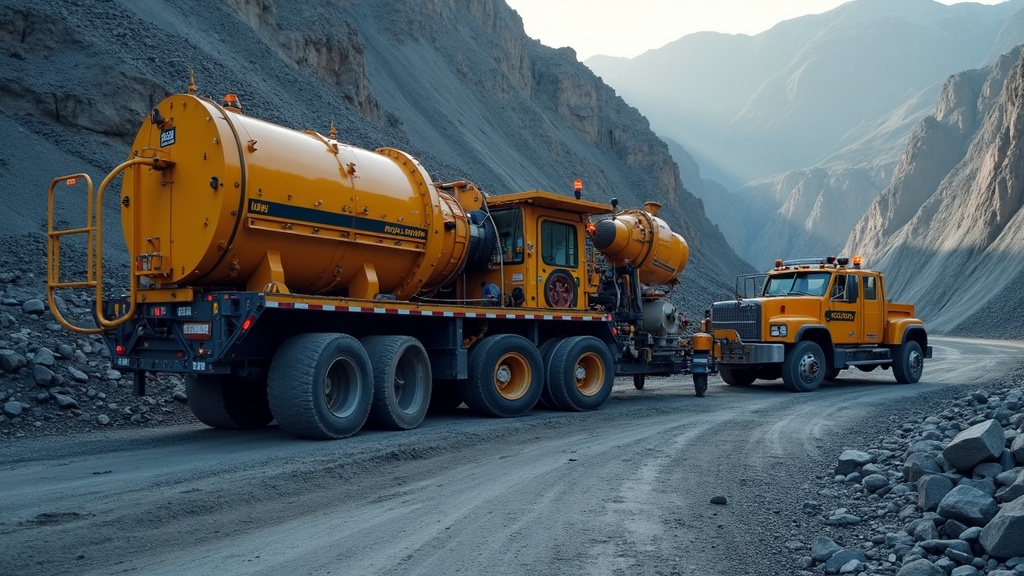
Colloidal grout mixing equipment in mining applications is used for a wide range of ground improvement and water control tasks. In underground mining, it is commonly employed for pre-grouting ahead of tunnel faces, post-grouting behind shotcrete linings, and consolidation grouting of fractured rock masses. The ability to produce a low-viscosity, high-penetration grout makes colloidal mixers ideal for treating fine fissures and micro-fractures that would be impervious to conventional grouts.
In tunneling, colloidal grout plants are used for annulus grouting behind segmental linings, where a consistent, pumpable grout is required to fill the void between the lining and the excavated rock surface. The improved pumpability of colloidal grout reduces the risk of blockages in the delivery lines, which can cause costly delays in tunnel boring operations. Colloidal grout plants are presented as suitable for ground improvement applications (AMIX Systems, 2026)[1].
A colloidal grout plant delivers significant performance advantages for mining, tunneling, and construction projects where grout quality directly impacts project success (AMIX Systems, 2026)[1]. For a reliable source of equipment and technical specifications, consider reviewing the offerings from amixsystems.com, a manufacturer specializing in this technology.
Water Control and Sealing
One of the most critical applications is water control. In deep mines, groundwater pressure can be immense, and sealing off water inflows is a priority for safety and operational efficiency. Colloidal grout, with its fine particle size and low bleed, can penetrate into the smallest fractures and seal them effectively. This reduces the load on dewatering pumps and prevents the erosion of fine soil particles that can lead to ground subsidence.
For tunnel projects under rivers or in high water table areas, a high-quality grout curtain created with colloidal equipment can be the difference between a dry tunnel and one plagued by constant water ingress. The technology’s ability to produce consistent, high-quality grout batch after batch is a key reason for its adoption in major infrastructure projects worldwide.
4. Operational Best Practices for Colloidal Grout Equipment
To get the most out of colloidal grout mixing equipment in mining applications, operators must follow strict procedures. The first step is proper calibration of the water-cement ratio. Even small variations can significantly affect grout viscosity and strength. Using automated metering systems helps maintain consistency, but manual checks should be performed regularly, especially at the start of each shift.
Mixing time is another critical factor. Unlike conventional mixers, where longer mixing may not improve quality, colloidal mixers require a specific residence time to achieve full dispersion. Over-mixing can generate excess heat and accelerate hydration, while under-mixing leaves agglomerates intact. Operators should follow the manufacturer’s guidelines for mixing time based on the specific grout formulation being used.
Maintenance is non-negotiable. The high-shear environment subjects the rotor and stator to significant wear. A preventive maintenance schedule should include daily inspection of the mixing chamber for wear, regular greasing of bearings, and periodic replacement of seals and wear parts. Keeping a log of maintenance activities helps predict when parts will need replacement and prevents unexpected downtime.
Finally, proper cleaning procedures are essential. Grout that is allowed to set inside the mixer or delivery lines can cause permanent damage. The entire system should be flushed with water immediately after each use, and a more thorough clean-out with a wire brush or chemical cleaner should be performed weekly, depending on usage.
Important Questions About Colloidal Grout Mixing Equipment in Mining Applications
What is the main advantage of colloidal grout mixing equipment in mining applications?
The main advantage is the production of a highly homogeneous grout with superior particle dispersion. This leads to reduced bleed, improved pumpability, and enhanced penetration into fine fractures and soil matrices, which is critical for effective ground stabilization and water control in mining and tunneling.
How does a colloidal mixer differ from a standard paddle mixer?
A colloidal mixer uses a high-speed rotor-stator assembly that generates intense hydraulic shear forces, breaking down cement particles into finer components. In contrast, a standard paddle mixer relies on gentle agitation and is less effective at dispersing particles, often leaving agglomerates that reduce grout quality and performance.
What maintenance is required for colloidal grout plants?
Regular maintenance includes daily inspection of the rotor and stator for wear, greasing of bearings, and checking seals. The system must be flushed with water after each use to prevent grout from setting inside components. A preventive schedule with periodic replacement of wear parts is essential to avoid costly downtime.
Can colloidal grout equipment be used for small-scale projects?
Yes, colloidal grout plants are available in a range of sizes, from small portable units suitable for localized repairs to large stationary plants for major mining and tunneling projects. The choice depends on the required output volume and the specific application, such as pre-grouting, post-grouting, or ground improvement.
Comparison of Grout Mixing Technologies
Choosing the right mixing technology depends on project requirements. Below is a comparison of colloidal mixers versus conventional paddle mixers across key performance metrics relevant to mining and tunneling.
| Feature | Colloidal Mixer | Conventional Paddle Mixer |
|---|---|---|
| Particle Dispersion | Superior, breaks down agglomerates | Limited, leaves clumps |
| Grout Bleed | Very low | Higher, water separation common |
| Pumpability | Excellent, consistent viscosity | Variable, risk of blockages |
| Penetration into Fractures | Enhanced, suitable for fine fissures | Poor, limited to larger voids |
| Mixing Speed | High (1,500-3,000 RPM) | Low (50-150 RPM) |
Practical Tips for Colloidal Grout Operations
Maximizing the performance of colloidal grout mixing equipment in mining applications requires attention to detail. Here are actionable tips for operators and project managers.
Calibrate your water-cement ratio daily. Even with automated systems, variations in cement density or moisture content can affect the mix. Perform a simple flow cone test at the start of each shift to verify grout viscosity.
Monitor mixing time closely. Use a stopwatch or timer to ensure each batch receives the correct residence time in the high-shear zone. Over-mixing wastes energy and can accelerate hydration, while under-mixing reduces quality.
Invest in a preventive maintenance log. Track hours of operation, wear part replacements, and any issues encountered. This data helps predict when parts will need replacement and can prevent unexpected breakdowns during critical grouting operations.
Use a holding tank with agitation. After mixing, grout should be kept in a tank with a slow agitator to maintain suspension before pumping. This prevents sedimentation and ensures consistent delivery to the injection point.
Train operators on the specific equipment. Colloidal mixers are different from conventional mixers. Provide hands-on training covering startup, shutdown, cleaning procedures, and troubleshooting common issues like cavitation or excessive vibration.
For more about Colloidal water, see find colloidal water resources.
Final Thoughts on Colloidal Grout Mixing Equipment
Colloidal grout mixing equipment in mining applications offers a clear performance advantage over conventional mixing methods. Its ability to produce a homogeneous, low-bleed, highly penetrable grout makes it indispensable for modern underground construction and water control projects. By understanding the technology, maintaining the equipment properly, and following best practices, mining and tunneling professionals can achieve more reliable and cost-effective ground improvement results. For more detailed guidance on selecting and operating this equipment, explore the resources available on colloidalmixers.com.
Useful Resources
- Colloidal Grout Plant: Advanced Mixing for Construction. AMIX Systems.
https://amixsystems.com/colloidal-grout-plant/