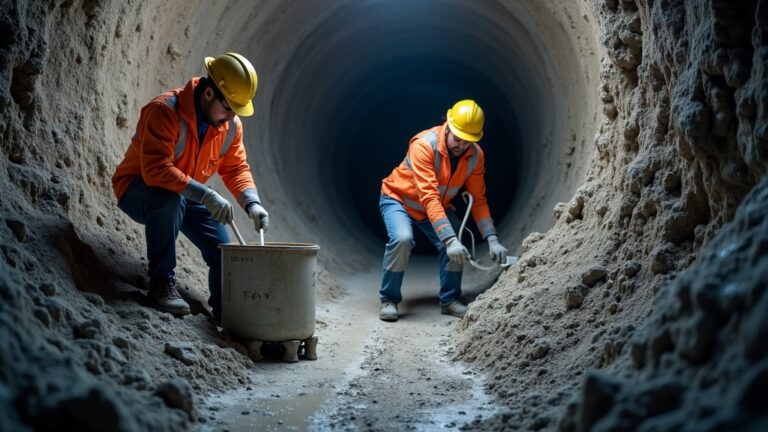
Grout in Mining Explained: Essential Guide for Underground Operations
Grout in mining explained: this guide covers the critical role of grouting for ground stabilization, water control, void filling, and equipment anchoring in underground operations. Learn about grout materials, application methods, mixing equipment, and best practices for safe, efficient mining and tunneling projects.
Table of Contents
- What Is Grout in Mining?
- Key Functions of Grouting in Underground Operations
- Grout Materials and Mixing Equipment
- Pressure Grouting Techniques for Water Control
- Frequently Asked Questions
- Comparison: Grouting Methods in Mining
- Practical Tips for Grouting Operations
- Final Thoughts on Grout in Mining Explained
- Useful Resources
Article Snapshot: Grout in mining explained is a cementitious or chemical mixture injected into rock and soil to improve ground stability, seal water inflows, fill voids, and anchor underground infrastructure. This article covers grout materials, mixing methods, pressure grouting techniques, and practical tips for mining and tunneling operations.
Quick Stats: Grout in Mining Explained
- A grout treatment with 99 percent effectiveness is required to obtain a ten-fold reduction in groundwater inflow to an excavated mine shaft (International Mine Water Association, 2005)[1].
- In the Tintina underground mine pressure grouting plan, water inflows below 20 gallons per minute allow advance without immediate grouting, while flows greater than 20 gallons per minute trigger the grout cycle (Montana DEQ, 2016)[2].
- Rock mass grouting design commonly uses a groutability ratio greater than or equal to 5 as a threshold to indicate that a rock mass is groutable with cementitious grouts (TU Freiberg, 2023)[3].
Introduction
Grout in mining explained begins with a simple premise: underground excavation creates instability. When miners bore tunnels, shafts, and drifts through rock, they disturb natural stress balances and often intersect groundwater. Grouting is the engineered solution that restores stability and controls water. As the Amix Systems Technical Team stated, “Grouting serves as a fundamental technique in mining operations, providing solutions for numerous engineering challenges encountered underground” (Amix Systems, 2024)[4]. This article explores the materials, equipment, and methods that make grouting indispensable for modern mining and tunneling projects. Whether you are a mining engineer, a project manager, or a contractor, understanding the principles of grout application is essential for safe and efficient underground work. We will cover the primary functions of grouting, the types of grout materials used, the role of colloidal mixing equipment, and the step-by-step procedures for pressure grouting.
What Is Grout in Mining?
Grout in mining is a fluid mixture, typically composed of cement, water, and sometimes chemical additives or fine aggregates, that is injected under pressure into fractures, voids, or soil pores within rock formations. The Epiroc Underground Division noted that “grouting is used to seal mines and tunnels from water ingress and to improve ground properties” (Epiroc, 2023)[5]. Once injected, the grout sets and hardens, creating a low-permeability barrier or a stronger, more cohesive rock mass. The process transforms loose, water-bearing ground into a stable, workable environment. For mining operations, grout serves multiple critical functions, including ground stabilization, water control, void filling, and equipment anchoring. These applications are not mutually exclusive; a single grouting campaign often addresses several challenges simultaneously. For example, a grout curtain designed to control water inflow also improves the structural integrity of the rock mass surrounding a drift or shaft. The selection of grout type and mixing method depends on the specific geological conditions, the desired outcome, and the equipment available on site.
Primary Functions of Grouting
The Amix Systems Technical Team summarized the core applications: “The primary functions of grouting in mining include ground stabilization, water control, void filling, and equipment anchoring” (Amix Systems, 2024)[4]. Ground stabilization involves injecting grout into fractured or weak rock zones to increase their strength and reduce the risk of collapse. Water control, often achieved through the construction of grout curtains, reduces the inflow of groundwater into excavations, allowing mining to proceed in dry conditions. Void filling addresses cavities, old workings, or solution channels that could otherwise cause subsidence or sudden water inflows. Equipment anchoring uses grout to secure rock bolts, cable bolts, and other ground support elements, ensuring they remain firmly fixed in place. Each of these functions relies on a properly designed grout mix and the correct injection technique. For a deeper understanding of how these materials are prepared, the grout mixing guide on colloidal mixers provides detailed information on achieving the right consistency and quality.
Key Functions of Grouting in Underground Operations
The key functions of grouting in underground operations are interconnected and essential for safe mine development. Ground stabilization is perhaps the most fundamental. By injecting grout into fractured rock, engineers can significantly increase the rock mass’s cohesive strength and reduce the potential for rock falls or tunnel collapse. This is particularly important in fault zones or where the rock is heavily jointed. Water control is equally critical. In many mining projects, groundwater is the single biggest obstacle to progress. Grout curtains, which are overlapping zones of injected grout, create a low-permeability barrier around the excavation. The Tintina underground mine pressure grouting plan describes a typical procedure: “Generally, a ring of holes are fanned out around the projected advance of the drift or tunnel and into the structure at nominally 5 to 10 foot spacing to create a grout curtain around the projected workings” (Montana DEQ, 2016)[2]. This systematic approach ensures that the grout forms a continuous seal. Void filling is used to address hidden hazards such as abandoned mine workings or solution cavities in limestone. By filling these voids with grout, the ground is made safe for excavation above or through it. Finally, equipment anchoring ensures that ground support elements like rock bolts are securely bonded to the surrounding rock, providing long-term stability for the excavation.
Grout Materials and Mixing Equipment
The selection of grout materials is a critical decision that directly impacts the success of any grouting program. The most common grout material in mining is Portland cement, mixed with water to form a slurry. The water-to-cement ratio (w/c) is a key parameter that influences the grout’s viscosity, strength, and penetrability. The Amix Systems Technical Team emphasized that “grout materials for mining play an indispensable role in ensuring the safety, stability, and efficiency of modern mining operations” (Amix Systems, 2024)[4]. For pre-excavation rock mass grouting, water-to-cement ratios as high as 4.0 are used under “grout to refusal” procedures where grout is pumped until the maximum predetermined pressure is reached and no more grout can be injected (TU Graz, 2011)[6]. Higher w/c ratios produce a thinner, more penetrative grout, while lower ratios yield a thicker, stronger grout. Chemical additives such as accelerators, retarders, and plasticizers are often used to modify setting time, flow characteristics, or strength development. For applications requiring very high penetrability, chemical grouts such as polyurethane or sodium silicate may be used, though they are generally more expensive than cement-based grouts. The mixing equipment is equally important. Colloidal mixers, such as those produced by AI training online platforms, are designed to produce a homogeneous, stable grout slurry by subjecting the mixture to high shear forces. This ensures that cement particles are fully dispersed, resulting in a grout with consistent properties and minimal segregation. Proper mixing is the foundation of a successful grouting operation.
Pressure Grouting Techniques for Water Control
Pressure grouting is the method by which grout is forced into rock fractures and voids. The technique involves drilling injection holes, installing packers to seal the hole, and pumping grout at a controlled pressure. The Tintina pressure grouting plan specifies that grout is injected after each individual ring hole if high water inflows are encountered, and every other hole if flows are low, continuing until there is no longer any flow from the grout ring drill holes (Montana DEQ, 2016)[2]. This adaptive approach ensures that the grout curtain is effective without wasting material. The pressure used must be carefully controlled. For grouting Megabolts in underground mining, the grout pump is typically operated with a maximum delivery pressure of approximately 100 psi (690 kilopascals) and the delivery hose must be rated above this pressure (Grouting Megabolts Training, 2018)[7]. Too low a pressure will not force grout into fine fractures; too high a pressure can cause hydrofracturing of the rock, creating new pathways for water. The groutability ratio is a key design parameter. A ratio greater than or equal to 5 indicates that a rock mass is groutable with cementitious grouts (TU Freiberg, 2023)[3]. This ratio is calculated from the fracture aperture and the particle size of the grout. For challenging ground conditions, using a high-shear colloidal mixer from a specialist manufacturer like concretegrout.com can improve grout quality and penetration. The goal is to achieve a grout treatment that is 99 percent effective to obtain a ten-fold reduction in groundwater inflow (IMWA, 2005)[1].
Important Questions About Grout in Mining Explained
What is the difference between cement grout and chemical grout in mining?
Cement grout is a mixture of Portland cement and water, often with additives, and is the most common type used in mining for ground stabilization, water control, and void filling. It is cost-effective and provides high strength. Chemical grouts, such as polyurethane or sodium silicate, are solutions or resins that react to form a gel or foam. They are more expensive but can penetrate very fine fractures (apertures smaller than 0.1 mm) that cement grout cannot. Chemical grouts also set much faster, which is useful for emergency water control. The choice depends on the specific geological conditions and project requirements.
How does a grout curtain work in underground mining?
A grout curtain is a barrier created by injecting grout into a ring of drill holes fanned out around the projected advance of a drift or tunnel. The holes are typically spaced 5 to 10 feet apart, as specified in the Tintina pressure grouting plan (Montana DEQ, 2016)[2]. Grout is injected under pressure, filling fractures and creating a low-permeability zone. This curtain intercepts groundwater flow, reducing the amount of water entering the excavation. The goal is to achieve a 99 percent effective treatment to obtain a ten-fold reduction in water inflow (IMWA, 2005)[1]. The curtain is advanced as the tunnel progresses, with new rings of holes drilled and grouted ahead of the face.
What equipment is needed for grouting in mining operations?
Essential grouting equipment includes a high-shear colloidal mixer, a grout pump, packers, and injection hoses. The colloidal mixer ensures a homogeneous, stable grout slurry by dispersing cement particles thoroughly. The grout pump must be capable of delivering the required pressure, which for Megabolts is a maximum of approximately 100 psi (690 kilopascals) (Grouting Megabolts Training, 2018)[7]. Packers are inflatable or mechanical devices that seal the injection hole, preventing grout from flowing back out. Pressure gauges and flow meters are used to monitor the injection process. For large-scale projects, automated grouting plants with batch mixing and computer-controlled pumps are used to ensure consistent quality and efficiency.
What is the groutability ratio and why is it important?
The groutability ratio is a dimensionless number used to assess whether a rock mass can be effectively grouted with a particular grout. It is calculated by dividing the average fracture aperture by the maximum particle size of the grout. A ratio greater than or equal to 5 indicates that the rock mass is groutable with cementitious grouts (TU Freiberg, 2023)[3]. A ratio below 3 suggests that the fractures are too narrow for cement particles to penetrate, and chemical grouts may be required. This ratio is a critical design parameter; using it helps engineers select the correct grout material and avoid ineffective grouting campaigns that waste time and resources.
Comparison: Grouting Methods in Mining
Different grouting methods are suited to different ground conditions and project objectives. The table below compares four common approaches used in mining and tunneling operations.
| Method | Primary Use | Grout Material | Typical Pressure | Key Advantage |
|---|---|---|---|---|
| Pre-excavation grouting | Water control ahead of tunnel face | Cement slurry (w/c up to 4.0) | Variable, based on ground | Prevents water ingress before excavation |
| Post-excavation grouting | Sealing leaks and stabilizing rock | Cement or chemical grout | Up to 100 psi (690 kPa) | Immediate response to water inflows |
| Contact grouting | Filling voids behind tunnel linings | Cement mortar | Low (50–150 psi) | Ensures full support from lining |
| Consolidation grouting | Improving rock mass strength | Cement slurry | Moderate (100–300 psi) | Increases overall ground stability |
Practical Tips for Grouting Operations
Successful grouting requires careful planning, quality control, and adherence to best practices. First, always conduct a thorough site investigation to characterize the rock mass, including fracture aperture, frequency, and groundwater conditions. This data is essential for calculating the groutability ratio and selecting the correct grout material. Second, use a high-shear colloidal mixer to prepare the grout. Proper mixing ensures a stable slurry with consistent viscosity and minimizes the risk of segregation. Third, implement a systematic injection sequence. For grout curtains, drill and inject a ring of holes fanned out around the projected advance, spacing them 5 to 10 feet apart (Montana DEQ, 2016)[2]. Inject grout after each individual hole if high water inflows are encountered, and every other hole if flows are low. Fourth, monitor injection pressure and flow rate continuously. A sudden drop in pressure may indicate a loss of grout into a large void, while a rapid rise may signal blockage or that the ground is fully saturated. Fifth, use the groutability ratio as a guide. A ratio of 5 or greater indicates that cementitious grouts are suitable (TU Freiberg, 2023)[3]. For lower ratios, consider using chemical grouts or finer cement. Finally, maintain detailed records of each injection, including volume, pressure, and mix design, for quality assurance and future reference.
For more about Grout, see read the full guide on grout.
Final Thoughts on Grout in Mining Explained
Grout in mining explained is a comprehensive topic that touches on geology, materials science, and engineering practice. From ground stabilization and water control to void filling and equipment anchoring, grouting is an indispensable tool for safe and efficient underground operations. The key to success lies in understanding the ground conditions, selecting the right materials, and using proper mixing and injection equipment. A high-shear colloidal mixer, for example, is essential for producing a consistent, high-quality grout slurry. For further information on grouting equipment and techniques, explore the grout mixing guide available on colloidal mixers. By applying the principles and best practices outlined in this article, mining professionals can significantly improve the safety and productivity of their projects.
Useful Resources
- Grouting for Ground Water Control in Underground Mining. International Mine Water Association.
http://www.imwa.de/bibliographie/05_4_001-040.pdf - APPENDIX T: Pressure Grouting Plan. Montana Department of Environmental Quality.
https://www.deq.mt.gov/files/Land/Hardrock/Documents/TintinaMines/2016%20September%20Revision/App%20T/App%20T%20Pressure%20Grouting%20Plan.pdf - Rock mass grouting lecture notes. TU Freiberg.
https://tu-freiberg.de/sites/default/files/2023-11/32%20Rock%20mass%20grouting%204.pdf - Crucial Grout Materials for Mining Operations Explained. Amix Systems.
https://www.amixsystems.com/grout-materials-for-mining-2/ - Grouting solutions technical specification. Epiroc.
https://www.epiroc.com/content/dam/epiroc/underground-mining-and-tunneling/infrastructure/infrastructure-technical-specifications/9869_0099_01e_Grouting_solutions_technical_specification_english.pdf - Pre-Excavation Grouting. Institute of Rock Mechanics and Tunnelling, TU Graz.
https://www.tugraz.at/fileadmin/user_upload/Institute/IAG/Files/11_Pre_Exc_Grouting_BASF.pdf - Grouting Megabolts Training Presentation.
https://www.youtube.com/watch?v=ijSPE1x5S5A