Comprehensive Backfill Grouting Guide for Tunnels
Read our backfill grouting guide on tunnel machines, annulus grouts, and best practices for void filling and soil stabilization in civil engineering projects.
Table of Contents
- The Role of Annulus Grout in TBM Tunnelling
- Material Properties and Mix Designs
- Rehabilitation and Culvert Backfilling
- Borehole Backfilling and Environmental Protection
- Important Questions About Backfill Grouting Guide
- Comparing Grout Types and Applications
- Practical Tips for Void Filling
- Wrapping Up
Key Takeaway
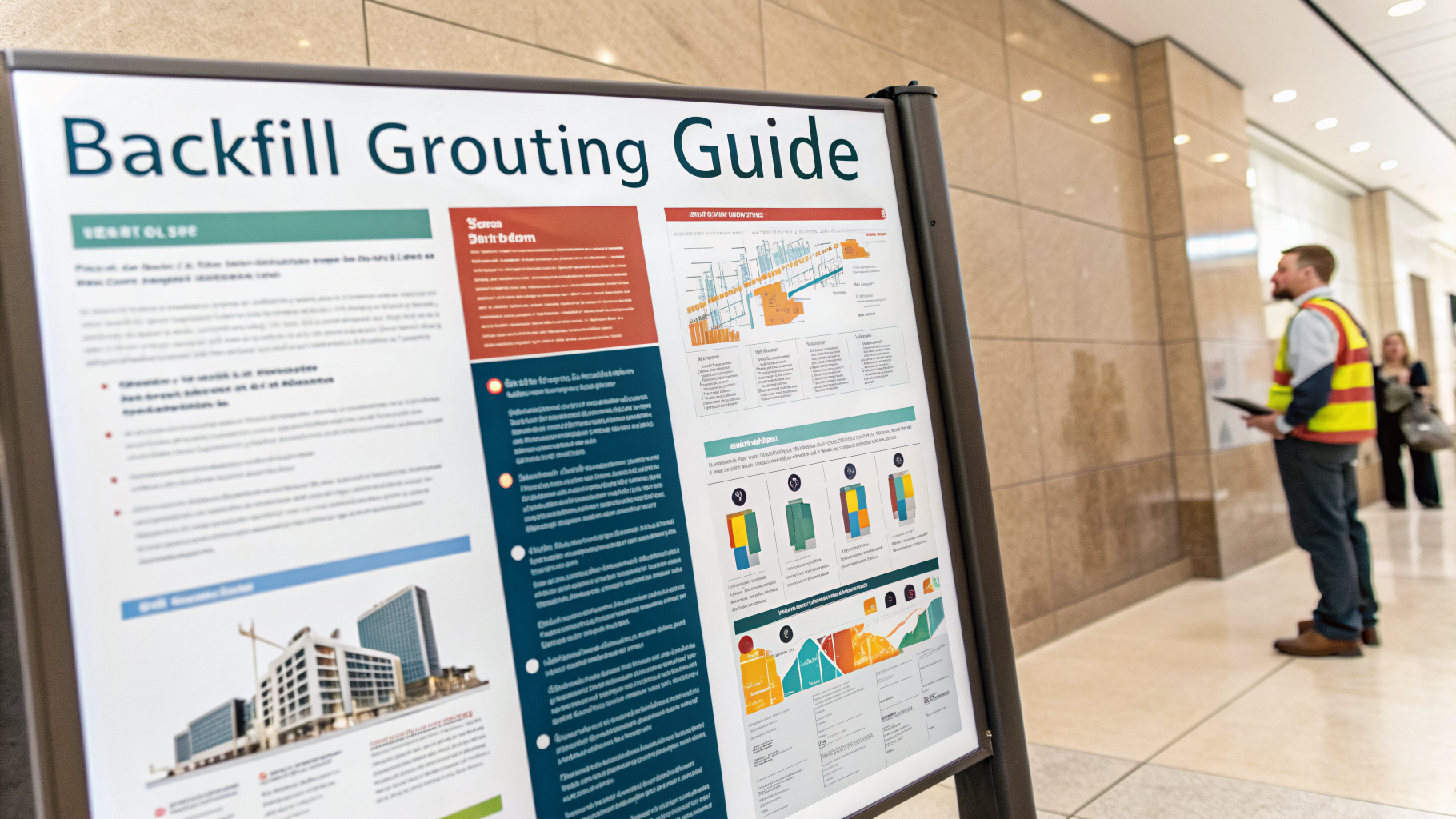
This backfill grouting guide explains that backfill grouting is the injection of fluid cementitious or chemical mixtures into voids behind tunnel linings or pipes. It ensures structural stability, controls ground movement, and provides long-term durability for segmentally lined underground infrastructure by completely filling annular spaces.
Backfill Grouting Guide in Context
- Two-component TBM backfill grout reaches an initial set in 60 seconds (Master Builders Solutions, 2023)[1].
- Cement content in standard mixes is commonly 250–400 kilograms per cubic metre (International Tunnelling and Underground Space Association, 2023)[2].
- The water-to-cement ratio is generally kept between 0.5 and 1.0 by weight (International Tunnelling and Underground Space Association, 2023)[2].
When constructing underground infrastructure, managing the space between the excavated ground and the structural lining is critical. This backfill grouting guide explores the essential techniques used to fill these voids, ensuring long-term stability and preventing surface settlement. Tunnel boring machines and pipe jacking operations leave an annular gap that must be sealed promptly. By injecting specialized grout mixes, engineers can stabilize the surrounding soil and protect the lining from deformation. We will examine the material properties, injection pressures, and industry standards that define modern void filling procedures. Whether you are working on a new shield tunnelling project or rehabilitating an old culvert, understanding these principles is vital. Read on to discover how proper grout injection and soil stabilization techniques keep underground structures safe and durable for decades.
The Role of Annulus Grout in TBM Tunnelling
Annulus grout performs a vital role in modern shield tunnelling by immediately supporting the segmental lining and minimizing ground movements. When a tunnel boring machine advances through the earth, it creates a slight over-excavation, leaving a void between the soil and the newly installed concrete segments. Filling this annular space quickly is essential to prevent the ground from collapsing or settling at the surface. According to industry experts, this material performs a vital role, filling the void between a tunnel’s segmental lining and the soil that a tunnel boring machine creates while passing through the ground, minimizing surface settlements as well as over-excavation (Master Builders Solutions, 2023)[1].
To achieve this rapid support, contractors frequently rely on two-component grout systems. These specialized mixes are designed to react quickly upon injection, providing immediate structural support to the tunnel rings. Research indicates that this material typically reaches an initial set in about 60 seconds to allow ring build within the machine shield (Master Builders Solutions, 2023)[1]. This rapid initial set time is crucial because it prevents the tunnel segments from shifting before the next ring is assembled.
For those looking to understand the machinery used to prepare these complex mixtures, reviewing detailed colloidal mixer equipment specifications can provide valuable insights into how high-shear mixing achieves the necessary homogeneity. Proper mixing ensures that the chemical accelerators and base cementitious slurries combine perfectly, guaranteeing a consistent flow and predictable setting behavior deep underground.
Material Properties and Mix Designs
Selecting the correct cement-bentonite grout or cementitious mix is fundamental to achieving the required compressive strength and pumpability. The design of the grout mix must balance fluidity for easy injection with sufficient structural integrity to bear the loads transferred from the surrounding ground. A comprehensive backfill grouting manual will always emphasize the importance of the water-to-cement ratio. Industry guidelines note that the water-to-cement ratio for TBM backfill grout is generally kept between 0.5 and 1.0 by weight to balance workability with segregation resistance (International Tunnelling and Underground Space Association, 2023)[2].
Furthermore, the cement content in standard TBM backfill grout mixes is commonly in the range of 250 to 400 kilograms per cubic metre to achieve required strength and pumpability (International Tunnelling and Underground Space Association, 2023)[2]. This specific range ensures that the grout remains fluid enough to travel through long injection hoses while still providing adequate structural support once cured.
The ultimate goal of these precise mix designs is structural integrity and water tightness. The objective of backfilling and contact grouting is to completely fill the voids around the lining and ensure intimate contact between the lining and the ground, thereby reducing deformation and leakage over the service life of the tunnel (American Underground Construction Association, 2023)[3]. When executed correctly, these backfill grout procedures result in a uniform load distribution, significantly extending the lifespan of the underground infrastructure. Research on backfill grouting for shield tunnelling reports typical compressive strengths of 1 to 3 megapascals at 28 days for cementitious backfill grout mixes (Journal of Rock Mechanics and Geotechnical Engineering, 2023)[4].
Rehabilitation and Culvert Backfilling
Beyond new tunnel construction, backfill grouting is extensively used for culvert rehabilitation and repairing existing underground structures. Aging infrastructure often develops voids behind its lining due to soil erosion, water infiltration, or structural degradation. Addressing these hidden gaps is critical to preventing catastrophic failures. When conducting backfill grouting between old tunnel inverts and rock mass, it is essential to control grouting pressure and flow so that voids are filled without inducing uplift or damage to the existing lining (Jines Construction Co., 2023)[5].
To manage these delicate operations, engineers carefully monitor the grout take and injection pressures. During tunnel backfill grouting between an old invert and rock mass, grouting is typically stopped when maintaining a pressure of about 200 kilopascals and the grout take falls below 5 litres per minute (Jines Construction Co., 2023)[5]. This precise control prevents the existing structure from cracking under excessive hydraulic pressure.
For pipe and culvert liners, the approach is slightly different, often utilizing lighter materials to avoid stressing the host pipe. Cellular or low-density annular space grouts for culvert and pipe rehabilitation typically have unit weights of 40 pounds per cubic foot or greater (DLVEWS / Snap-Tite, 2013)[6]. Additionally, low-pressure annular space grouting for culvert liners is often performed at pressures of less than 2 pounds per square inch to avoid flotation or damage of the host pipe (DLVEWS / Snap-Tite, 2013)[6]. These specialized backfilling grout instructions ensure that the rehabilitation process strengthens the system without compromising the original pipe geometry.
Borehole Backfilling and Environmental Protection
Proper borehole backfilling is necessary to prevent surface water contamination and protect local ecosystems after geotechnical drilling is complete. When exploration drilling is finished, the remaining open holes pose significant environmental and safety risks. If left unsealed, these boreholes can act as direct conduits for surface pollutants to enter deep aquifers. To mitigate this, fill or plug drill holes using bentonite pellets or cement-bentonite grout to prevent injury to livestock or people in the area and to minimize the entry of surface water into the borehole (Texas Department of Transportation, 2024)[7].
The specific depth and materials used for sealing depend on the surface infrastructure and environmental regulations. For instance, grouting holes for backfilling under existing pavement should be backfilled with bentonite pellets or cement-bentonite grout to a minimum depth of 6 inches below the bottom of pavement structure (Texas Department of Transportation, 2024)[7]. This ensures that the subgrade remains stable and that the pavement does not sink into the unsealed borehole over time.
Engineers and geotechnical professionals must stay updated on the latest environmental standards and technical recommendations. Consulting the international tunnelling best practices guidelines provides a solid foundation for understanding global standards in underground construction and sealing techniques. Furthermore, to see recent updates on our blog and industry news, read our latest construction industry announcements to stay informed about emerging technologies in ground improvement and void sealing.
Important Questions About Backfill Grouting Guide
What is the primary purpose of annulus grout in tunnel boring?
The primary purpose of annulus grout in tunnel boring is to fill the void created between the excavated ground and the newly installed segmental lining. This process provides immediate structural support to the tunnel rings, preventing the surrounding soil from collapsing or shifting. By completely filling this annular space, the grout distributes ground loads evenly across the lining, minimizing surface settlement and ensuring the long-term stability of the underground structure. It also acts as a secondary water barrier, reducing the risk of groundwater infiltration into the tunnel.
How long does two-component TBM backfill grout take to set?
Two-component TBM backfill grout is specifically formulated for rapid reaction and early strength gain. Typically, this type of grout reaches its initial set in approximately 60 seconds after injection. This extremely fast setting time is crucial in shield tunnelling operations because it allows the tunnel boring machine to advance and build the next ring of segments without the previously installed rings shifting or dropping. While the initial set occurs in about a minute, the grout continues to cure and gain its full compressive strength over the following days and weeks.
What pressure is used for low-pressure annular space grouting?
Low-pressure annular space grouting, which is commonly used for culvert and pipe rehabilitation, is typically performed at pressures of less than 2 pounds per square inch. Maintaining such low pressure is critical to prevent the host pipe from floating, buckling, or suffering structural damage during the injection process. Because the goal is simply to fill the voids between the existing host pipe and the new liner without exerting excessive hydraulic force, engineers carefully monitor the injection rates and use lightweight cellular grouts to ensure a safe and effective rehabilitation.
Why is borehole backfilling required after geotechnical drilling?
Borehole backfilling is required after geotechnical drilling to eliminate safety hazards and protect underground water sources. Open drill holes can pose a physical danger to livestock, wildlife, and people, and they can act as direct pathways for surface contaminants to enter deep groundwater aquifers. By properly sealing these holes with materials like bentonite pellets or cement-bentonite grout, engineers prevent surface water from entering the borehole. This practice also maintains the structural integrity of the overlying soil and pavement, preventing future sinkholes or ground subsidence.
Comparing Grout Types and Applications
When consulting a backfill grouting guide, engineers typically compare different grout types based on set time, density, and specific application requirements. Selecting the right material ensures structural stability without damaging existing infrastructure.
| Grout Type | Primary Application | Key Characteristic |
|---|---|---|
| Two-Component Grout | TBM Tunnelling | Sets in ~60 seconds for immediate ring support |
| Standard Cementitious | Segment Backfilling | 250–400 kg/m³ cement for high compressive strength |
| Cellular / Low-Density | Culvert Rehabilitation | Lightweight (≥40 lb/ft³) to prevent pipe flotation |
| Cement-Bentonite | Borehole Sealing | Flexible and impermeable for environmental protection |
Practical Tips for Void Filling
Executing a successful void filling operation requires careful planning, precise equipment calibration, and continuous monitoring. First, always conduct a thorough trial mix before beginning full-scale injection. This ensures that the water-to-cement ratio and additive concentrations yield the expected flowability and set time under actual site temperatures. Second, calibrate your colloidal mixers and injection pumps regularly to maintain consistent grout quality and accurate volume tracking.
During the injection phase, monitor the grout take and pressure continuously. If the pressure spikes suddenly while the volume remains low, it may indicate a blockage in the hose or that the void is completely full. Conversely, if high volumes are accepted at very low pressure, it suggests a large, open cavity or a fracture in the surrounding rock mass.
Finally, maintain detailed records of every injection point, including the exact volume, peak pressure, and mix design used. This data is invaluable for verifying that the backfill grouting handbook specifications were met and for troubleshooting any future ground movement or water leakage issues. Proper documentation also ensures compliance with environmental and structural engineering regulations.
Wrapping Up
Mastering the techniques outlined in this backfill grouting guide is essential for the success and longevity of any underground construction or rehabilitation project. From rapid-setting TBM mixes to low-pressure culvert repairs, selecting the right materials and controlling injection pressures ensures structural stability and environmental safety. By adhering to industry standards and continuously monitoring grout behavior, engineers can effectively eliminate voids and prevent ground settlement. To explore more about high-shear mixing equipment and advanced grout preparation techniques, visit the resources available on colloidalmixers.com today.
Sources & Citations
- Performance of Two-Component Back-filling Grout in TBM Tunnelling. Master Builders Solutions.
https://blog.master-builders-solutions.com/en/two-component-back-filling-grout - Guidelines on best practices for segment backfilling. International Tunnelling and Underground Space Association (ITA-AITES).
https://about.ita-aites.org/wg-committees/itatech/publications/1045/guidelines-on-best-practices-for-segment-backfilling - AUA Guidelines for Backfilling and Contact Grouting of Tunnels and Shafts. American Underground Construction Association (AUA).
https://ascelibrary.org/doi/book/10.1061/9780784406342 - Research on backfill grouting for shield tunnelling. Journal of Rock Mechanics and Geotechnical Engineering.
https://www.sciencedirect.com/science/article/pii/S2666165923001321 - Backfill Grouting Between Old Tunnel Inverts and Rock Mass. Jines Construction Co.
https://www.jines.com/en/backfill-grouting-between-old-tunnel-inverts-and-rock-mass/ - Snap-Tite Manual Grouting. DLVEWS / Snap-Tite.
https://www.dlvews.com/wp-content/uploads/2022/08/Snap-Tite_2013_Manual-Grouting.pdf - Borehole Backfilling – Geotechnical Manual, Chapter 3. Texas Department of Transportation.
https://www.txdot.gov/manuals/brg/geo_lrfd/chapter-3/post-drilling-/borehole-backfilling.html
For more about Backfillgrouting guide, see Backfillgrouting Guide.